
What Does Financial Empowerment Mean for You?
Discover what financial empowerment means for you. Gain the confidence to make informed money decisions and take control of your financial future.
 Planned Team·
What Does Financial Empowerment Mean for You?
TL;DR:
- Financial empowerment is the confidence and ability to make informed financial decisions and control one’s money. It involves progressing from education to practical skills and achieving financial wellness through consistent behavior and confidence.
Financial empowerment is the ability and confidence to make informed decisions about your money, giving you real control over your financial life. It’s not about earning a certain amount or hitting a specific milestone. It’s about having the knowledge, skills, and self-assurance to manage your finances on your own terms, regardless of where you’re starting from.
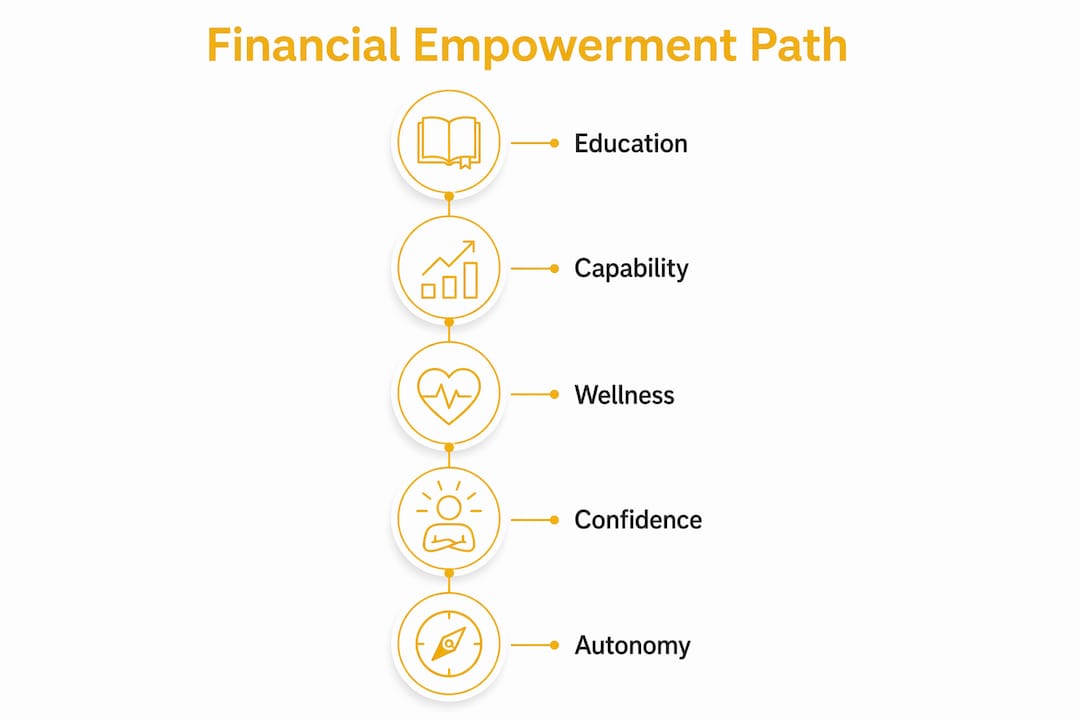
The National Disability Institute describes financial empowerment as the ability and confidence to make positive financial decisions that promote long-term stability and well-being. The Charles Schwab Foundation frames it as a progression from education to capability to lasting wellness. Together, these definitions point to three core elements:
- Financial education: Understanding how money works, including budgeting, saving, investing, and managing credit
- Financial capability: Putting that knowledge into practice through consistent, healthy financial behaviors
- Financial wellness: Reaching a state of security and satisfaction where financial stress no longer runs your life
You don’t need to master all three overnight. Think of them as a path, not a checklist.
Why financial education is the foundation of real empowerment
Financial education gives you the vocabulary and tools to make sense of your money before you’re forced to. Without it, you’re making decisions in the dark, and that’s where costly mistakes happen.
The Charles Schwab Foundation’s Money Matters program shows what’s possible when education is delivered well. Since 2003, over 1 million participants have completed the program, with measurable improvements in saving and budgeting skills. That’s not a small sample. It’s proof that structured financial education produces real behavioral change.
Pro Tip: Start your financial education by picking one area you feel least confident about, whether that’s credit scores, investing basics, or building a budget, and spend 30 minutes a week on just that topic. Depth beats breadth when you’re building a foundation.
Early exposure to financial concepts tends to produce better long-term outcomes. When you understand compound interest at 22, you make different choices than someone who learns it at 42. The FDIC’s Money Smart program is one free resource designed to build exactly this kind of foundational knowledge across all life stages.
- Budgeting: Knowing where your money goes each month
- Saving: Building habits that protect you from financial shocks
- Investing: Understanding how money can grow over time
- Credit management: Using debt as a tool, not a trap
Financial education also evolves with you. As the Charles Schwab Foundation notes, lifelong learning is what keeps empowerment intact through major life changes like job loss, marriage, or retirement.
How financial capability turns knowledge into real-world control
Knowing what to do and actually doing it are two very different things. Financial capability is the bridge between the two. It’s the active, consistent use of financial knowledge to make better decisions day to day.

Think of it this way: you might know that carrying a credit card balance costs you money in interest. Financial capability is what gets you to actually pay it down, set up automatic payments, and stop adding to it. The knowledge alone doesn’t change your bank account. The behavior does.
Here’s what financial capability looks like in practice:
- Tracking your spending every month so you know exactly where your money is going
- Building and sticking to a budget that reflects your actual income and real priorities
- Managing debt actively by targeting high-interest balances first and avoiding new debt where possible
- Saving consistently, even in small amounts, toward a specific goal
- Reviewing your financial picture regularly to catch problems early and adjust your plan
One underrated starting point is a financial health assessment. Before you can improve your financial capability, you need an honest look at where you stand. What do you know? What are you avoiding? What behaviors are costing you money? Answering those questions honestly is often the hardest and most useful step.
Empowered individuals, according to WallStreetMojo, plan for retirement, respond to emergencies without panic, and pursue financial goals with intention rather than hope.
What financial wellness actually looks like
Financial wellness isn’t a destination you arrive at. It’s a continuum, and most people sit somewhere in the middle of it at any given time.
At one end is financial stress: living paycheck to paycheck, avoiding your bank account, feeling anxious every time an unexpected bill shows up. At the other end is financial satisfaction: a funded emergency account, manageable debt, a retirement plan in motion, and the confidence that you can handle what comes next. The National Disability Institute describes this continuum as shaped by personal security measures and individual financial goals, not by income alone.
How does my money actually stack up?
Most people feel behind financially but have no idea where they actually stand.
| Wellness level | What it feels like | Key indicators |
|---|---|---|
| Financial stress | Constant worry, reactive decisions | No savings, high-interest debt, missed payments |
| Financial stability | Basic needs covered, some breathing room | Emergency fund started, bills paid on time |
| Financial security | Confident, proactive planning | Savings growing, debt declining, goals in place |
| Financial satisfaction | Calm, in control, future-focused | Retirement funded, financial goals being met |
Financial stress doesn’t stay in your bank account. Research from the National Disability Institute shows that financial stress negatively affects job performance, goal pursuit, and physical health. Getting to a better place on the wellness continuum isn’t just about money. It’s about your quality of life. Practical strategies for reducing financial stress can make a measurable difference in how you feel day to day.
Why financial empowerment matters beyond your own bank account
Financial empowerment changes how you move through the world. When you’re not constantly stressed about money, you make clearer decisions, take better care of your health, and show up more fully in your relationships and your work.
The CFPB’s framing matters here. Financial autonomy isn’t just a personal benefit. It’s a form of protection. People who understand their finances are less likely to fall for predatory lending, misleading financial products, or high-fee services that drain wealth over time.
At the community level, the impact compounds. WallStreetMojo notes that empowered individuals contribute to economic resilience and community growth through sound financial decision-making, supporting self-sufficiency and local innovation. When more people in a community reach financial stability, the whole community becomes more resilient.
Confidence and autonomy: the two drivers most people overlook
Most conversations about financial empowerment focus on knowledge. But knowledge without confidence doesn’t produce change. You can read every personal finance book ever written and still freeze when it’s time to open a brokerage account or negotiate a salary.
Confidence in managing your finances is earned through applying knowledge successfully, not just acquiring it. Every time you stick to a budget, pay off a debt, or make a savings goal, you build the evidence that you can do this. That evidence is what makes the next step feel possible rather than terrifying.
Pro Tip: If you feel stuck, start with the smallest financial win you can actually achieve this week. Pay off one small balance, set up a $25 automatic transfer, or review your subscriptions and cancel one. Small wins build the confidence that bigger moves require.
Autonomy works alongside confidence. The CFPB defines financial well-being as having control over day-to-day finances, the capacity to absorb a financial shock, and the freedom to make choices that allow you to enjoy life. That’s autonomy in practice.
One common misconception worth naming directly: financial empowerment does not require a high income. The National Disability Institute is clear that empowerment is accessible regardless of earnings. The first step is recognizing what you don’t know and where your barriers actually are, whether that’s debt, lack of product knowledge, or simply never having been taught. Identifying those gaps honestly is often what breaks the cycle. You can explore what building financial confidence actually looks like in practice to get started.
Financial empowerment in practice: what it looks like for real people
Financial empowerment shows up differently depending on where someone starts. Here are a few concrete examples of what the progression can look like.
From paycheck to paycheck to a funded emergency account. Someone earning $38,000 a year who has never had savings doesn’t become financially empowered by getting a raise. They get there by tracking spending for one month, finding $150 they were wasting, and automating that amount into a savings account. Six months later, they have a buffer. That buffer changes how they respond to a car repair or a medical bill. The stress response shifts.
Financial empowerment for women in particular. Women face specific structural barriers, including wage gaps, career interruptions for caregiving, and historically less access to financial education. Financial empowerment for women often means building the confidence to invest independently, negotiate compensation, and plan for a longer retirement horizon. Programs focused on financial literacy and empowerment for women have shown that targeted education and peer support accelerate the shift from financial anxiety to financial confidence.
Recovering from debt. Someone carrying $12,000 in credit card debt across four cards doesn’t need to feel shame. They need a plan. Financial capability means choosing a payoff strategy, like the avalanche method targeting highest-interest debt first, and sticking to it month after month. The empowerment comes not from being debt-free yet, but from being in control of the process.
These aren’t extraordinary stories. They’re what happens when knowledge, confidence, and consistent behavior work together.
Key Takeaways
Financial empowerment is built on three interconnected elements: education, capability, and wellness, and confidence is what turns knowledge into lasting change.
| Point | Details |
|---|---|
| Education comes first | Financial education builds the foundation for every other empowerment skill, from budgeting to investing. |
| Capability requires action | Knowing what to do only counts when you apply it consistently through real financial behaviors. |
| Wellness is a continuum | Financial wellness ranges from stress to satisfaction, shaped by personal goals and security measures, not income alone. |
| Confidence is earned, not given | Confidence grows through applying knowledge successfully, and each small win makes the next step more achievable. |
| Empowerment is accessible to everyone | You don’t need a high income to become financially empowered; recognizing your knowledge gaps is the critical first step. |
FAQ
What does financial empowerment mean in simple terms?
Financial empowerment means having the knowledge, confidence, and control to make good decisions about your money and manage your finances on your own terms, regardless of your income level.
How do you empower people financially?
Financial empowerment starts with education, moves into building practical skills like budgeting and debt management, and deepens through consistent behavior that builds confidence over time. Programs like the FDIC’s Money Smart and the Charles Schwab Foundation’s Money Matters are designed to support exactly this progression.
Who is a financially empowered woman?
A financially empowered woman understands her financial situation, makes independent decisions about saving, investing, and planning for retirement, and has the confidence to advocate for her own financial interests, including negotiating pay and building long-term wealth.
What is a red flag for a financial advisor?
A financial advisor who discourages you from asking questions, pushes products without explaining fees, or can’t clearly explain how they are compensated is a red flag. The Consumer Financial Protection Bureau recommends working with advisors who act as fiduciaries, meaning they are legally required to act in your best interest.
What’s the difference between financial literacy and financial empowerment?
Financial literacy is the knowledge of how money works. Financial empowerment goes further: it combines that knowledge with the confidence and capability to act on it, turning information into real financial control and long-term stability.
Recommended
The Role of Budgeting in Debt Reduction: 2026 Guide
Discover the role of budgeting in debt reduction. Learn how to create a plan that ensures payments and channels funds toward debt payoff.
What Is a Personal Financial Assessment?
A personal financial assessment scores your income, debt, savings, and cash flow from 0 to 100 so you know exactly what to fix first. Here is how to run one.
The Best Fin100X.AI Alternatives for U.S. Users in 2026
Fin100X.AI is an India-only public-sector platform. Here are 11 U.S. AI alternatives for portfolio monitoring and support automation, compared.
What Is Adaptive Financial Guidance and Why It Matters
Adaptive financial guidance updates your plan as your income, spending, and goals change. Here’s how it works and why it beats static, once-a-year advice.
See my financial health score.
Most people feel behind but have no idea where they actually stand. Score yourself across all 10 areas in 2 minutes.
Am I on track?