The Best Fin100X.AI Alternatives for U.S. Users in 2026
Fin100X.AI is an India-only public-sector platform. Here are 11 U.S. AI alternatives for portfolio monitoring and support automation, compared.
 Planned Team·
TL;DR:
- Fin100X.AI is a government platform based in India that lacks features like broker connectivity for U.S. retail investors.
- U.S. alternatives include software focused on financial analytics or customer support automation, such as Sierra AI and Salesforce Agentforce.
If you’re searching for fin100x.ai alternatives, the short answer is this: Fin100X.AI is an India-based, public-sector governance platform that lacks U.S. retail investment features like broker connectivity and private portfolio tracking. For U.S. users, the real options are commercial AI platforms built for financial analytics, customer support automation, or both. Here are the top ones worth your time:
- Salesforce Agentforce - Enterprise customer service automation with deep CRM integration
- Forethought - Specialist AI for mid-size to large customer support teams
- Sierra AI - Real-time portfolio monitoring for financial professionals
- Decagon - Budget-friendly chat automation for small businesses
- Ada - Omnichannel customer engagement with highly customizable workflows
- Hugo - Transparent pricing starting at $0.05 per interaction for cost-conscious users
- Featurebase Fibi - Metrics-driven AI support focused on cost per resolution
- My AskAI - Personalized AI assistance combining finance expertise with automation
- eesel AI - Mid-tier AI balancing support automation with user-friendly setup
- Parahelp - Ticket-handling AI for efficient, automated support resolution
- Lorikeet - Hybrid platform blending customer engagement with financial data intelligence
The best AI financial planning apps for U.S. users differ significantly from Fin100X.AI’s mission. Fin100X.AI’s Maha AI targets sovereign governance and citizen services in India, not commercial investing or business customer support. That context frames everything below.
What are the best fin100x.ai alternatives in 2026?
The 11 platforms above split into two broad categories: AI tools built for financial analytics and portfolio management, and AI tools built for customer support automation. Choosing between them depends entirely on whether you need analytical insight or automated execution. Some platforms, like Lorikeet and Sierra AI, sit closer to the finance side. Others, like Salesforce Agentforce and Ada, are purpose-built for support operations.
| Platform | Best For | Core AI Capability | Pricing Model | Cost Per Conversation |
|---|---|---|---|---|
| Salesforce Agentforce | Enterprise support automation | CRM-integrated AI agents | Enterprise subscription | Not publicly listed |
| Forethought | Mid-to-large support teams | Automated support workflows | Tiered subscription | Not publicly listed |
| Sierra AI | Financial professionals | Live portfolio monitoring | Not publicly listed | Not publicly listed |
| Decagon | Budget-conscious small businesses | Modular chat automation | Usage-based | Low |
| Ada | Enterprise omnichannel support | Customizable AI workflows | Enterprise subscription | Not publicly listed |
| Hugo | Budget-minded users | AI finance support | Per-interaction | $0.05 per interaction |
| Featurebase Fibi | ROI-focused support teams | Resolution-speed optimization | Metrics-based pricing | Optimized per resolution |
| My AskAI | Specialist firms | Personalized AI responses | Tiered subscription | Not publicly listed |
| eesel AI | Mid-tier enterprises | Support and finance automation | Tiered subscription | Not publicly listed |
| Parahelp | Automated ticket resolution | AI-driven ticket handling | Usage-based | Not publicly listed |
| Lorikeet | Hybrid finance and CX enterprises | Customer engagement + financial data | Enterprise subscription | Not publicly listed |
Rather not work this out alone? See how 1:1 coaching with a CFP® professional works.
Salesforce Agentforce
Salesforce Agentforce is the strongest choice for enterprises already running on the Salesforce ecosystem. It deploys AI agents across sales, service, and support workflows, pulling from your existing CRM data to personalize every interaction. The depth of integration with tools like Salesforce Service Cloud and Einstein Analytics sets it apart from standalone chatbot platforms. If your team already lives in Salesforce, the learning curve is minimal.

Forethought
Forethought focuses specifically on reducing agent workload through conversation AI. It triages incoming tickets, suggests responses, and resolves common queries without human intervention. Mid-size support teams report meaningful reductions in first-response time after deployment. The platform integrates with Zendesk, Salesforce, and Freshdesk, which covers most enterprise support stacks.
Sierra AI
Sierra AI targets financial professionals who need live portfolio insights, not generic market summaries. It connects directly to broker accounts and monitors positions in real time, flagging material changes before they become problems. That live-data focus puts it in a different category from research-only tools. Asset class exposure matters here: Sierra AI suits equity-heavy portfolios more than crypto or DeFi-heavy ones.
Decagon
Decagon is the entry point for small businesses that want AI chat without enterprise pricing. Its modular architecture lets you start with basic FAQ automation and add capabilities as your needs grow. The cost structure stays low, which makes it a practical first step for teams that have never deployed AI support before.

Ada
Ada’s strength is customization at scale. You can build complex, branching conversation flows without writing code, and deploy them across web, mobile, and messaging channels simultaneously. Enterprises with global customer bases use Ada because it handles multilingual support natively. The platform’s no-code workflow builder is genuinely one of the more accessible ones in this category.
Hugo
Hugo publishes its pricing openly, starting at $0.05 per interaction. That transparency is rare in this space and makes budgeting straightforward. For individuals or small teams that need AI finance support without committing to an enterprise contract, Hugo’s per-interaction model removes the guesswork entirely.
Featurebase Fibi
Featurebase Fibi takes a metrics-first approach to customer support AI. The platform tracks cost per resolution as a primary KPI and adjusts workflows to improve that number over time. Businesses that have already deployed AI support and want to squeeze more efficiency out of it will find Fibi’s reporting layer genuinely useful.
My AskAI
My AskAI lets specialist firms train an AI assistant on their own documentation, policies, and knowledge base. The result is a bot that answers questions with context specific to your business rather than generic responses. Financial advisory firms use it to handle client queries about account details, product terms, and compliance FAQs without routing everything to a human advisor.
eesel AI
eesel AI positions itself between the complexity of enterprise platforms and the simplicity of basic chatbots. It connects to tools like Notion, Google Docs, and Confluence, then uses that content to answer support queries automatically. The configuration process is lighter than Salesforce Agentforce or Ada, which makes it a reasonable fit for mid-tier teams that want meaningful automation without a long implementation cycle.
Parahelp
Parahelp specializes in ticket resolution. It reads incoming support tickets, categorizes them, drafts responses, and routes complex cases to the right human agent. The workflow is straightforward, and the platform is designed to be operational quickly. Teams dealing with high ticket volumes and limited staff find it particularly useful.
Lorikeet
Lorikeet blends customer experience AI with financial data intelligence, which makes it unusual in this list. It suits enterprises that need to handle both client-facing support and internal financial analytics from a single platform. The hybrid positioning means it does neither job as deeply as a pure-play specialist, but for teams that genuinely need both, it avoids the overhead of running two separate systems.
How to evaluate and choose the right fin100x.ai alternative
The most common mistake buyers make is choosing a platform based on feature lists rather than actual use case fit. Before you compare pricing or integrations, get clear on one question: do you need a tool that analyzes financial data, or one that acts on customer interactions? These two categories serve fundamentally different purposes, and conflating them leads to expensive mismatches.
Once you know your category, work through these steps:
- Define your primary function. Portfolio monitoring, customer support automation, and financial research are distinct needs. Pick the one that drives the most value for your team.
- Check integration compatibility. Confirm the platform connects to your existing CRM, broker accounts, or helpdesk software before you commit. A tool that doesn’t plug into your stack creates more work, not less.
- Evaluate pricing structure honestly. Per-interaction pricing like Hugo’s $0.05 model suits low-volume users. Subscription models suit teams with predictable, high-volume usage. Neither is universally better.
- Ask about compliance and data handling. U.S. financial platforms must meet specific regulatory standards. Verify SOC 2 compliance and data residency policies before signing anything.
- Request a pilot or sandbox. Most enterprise platforms offer trial access. Use it to test the specific workflows you care about, not the demo scenarios the vendor prefers.
Pro Tip: If your primary need is financial analytics, look for platforms with live broker connectivity rather than research-only tools. A hybrid setup pairing one live-monitoring tool with one research platform often outperforms any single platform trying to do both.
The AI financial advisor vs. human question also shapes this decision. If your team needs judgment calls on complex financial situations, a human-in-the-loop model still outperforms fully automated AI. If you’re handling high-volume, repeatable queries, automation wins on cost and speed.
Quick summary: which fin100x.ai alternative fits your situation?
Not every platform deserves the same amount of your attention. Here’s where each one lands for the three most common buyer profiles:
- Budget-conscious users: Hugo’s per-interaction pricing model and Decagon’s modular entry-level structure are the clearest starting points. Both avoid long-term commitments while delivering real automation.
- Specialist firms and mid-size teams: My AskAI, eesel AI, and Forethought all offer meaningful customization without enterprise-level complexity or pricing. My AskAI is particularly strong for knowledge-heavy environments like financial advisory.
- Enterprise deployments: Salesforce Agentforce and Ada lead this category. Agentforce wins when you’re already on Salesforce. Ada wins when you need omnichannel flexibility across global markets.
- Financial analytics specifically: Sierra AI and Lorikeet serve this need most directly. Sierra AI suits portfolio monitoring; Lorikeet adds a customer-facing layer on top.
- Ticket resolution at scale: Parahelp and Featurebase Fibi both address high-volume support operations, with Fibi adding a cost-per-resolution optimization layer that Parahelp doesn’t emphasize.
- Integration depth: Salesforce Agentforce and Forethought connect most broadly to existing enterprise stacks, covering Zendesk, Freshdesk, and Salesforce Service Cloud natively.
How these platforms have delivered results in practice
Salesforce Agentforce has been deployed across financial services firms to handle account inquiry automation, reducing the volume of calls reaching human agents for routine balance and transaction questions. The CRM integration means the AI already knows the customer’s history before the conversation starts, which shortens resolution time.
Forethought has been used by SaaS companies and financial platforms alike to triage support queues. Teams report that the platform’s ability to auto-resolve common queries means human agents spend more time on complex cases that actually require judgment.
Ada’s global deployment capability has made it a go-to for financial institutions with international customer bases. A single workflow can serve customers in multiple languages across web chat, mobile apps, and messaging platforms simultaneously, without building separate bots for each channel.
My AskAI’s knowledge-base training approach has worked well for registered investment advisors and financial planning firms. By training the AI on their specific product documentation and compliance materials, these firms handle a higher volume of client questions without expanding their support headcount.
What to expect from customer support and service quality
Support quality varies significantly across these platforms, and it often correlates with pricing tier. Enterprise platforms like Salesforce Agentforce and Ada typically include dedicated account managers, onboarding specialists, and SLA-backed response times. That level of support comes at a cost, but for large deployments, it’s the difference between a smooth rollout and a months-long implementation struggle.
Mid-tier platforms like eesel AI and My AskAI tend to offer self-serve documentation, community forums, and email support. Response times are reasonable for non-urgent issues, but you won’t get a dedicated contact. Decagon and Parahelp sit in a similar range, with support quality scaling up as you move to higher plan tiers.
Hugo’s transparent pricing model extends to its support structure: what you see is what you get. For budget-focused users, that predictability is reassuring even if the support depth is lighter than enterprise alternatives.
Security and compliance features for U.S. financial platforms
Any AI platform handling financial data in the U.S. needs to meet a baseline of security and regulatory standards. The key ones to verify before signing a contract:
SOC 2 Type II certification is the minimum credibility signal for data security. It confirms the platform has been independently audited for how it handles, stores, and protects customer data. Salesforce Agentforce, Ada, and Forethought all maintain SOC 2 compliance. Verify current certification status directly with each vendor, as certifications require annual renewal.
Data residency matters for financial firms subject to state-level regulations or internal data governance policies. Confirm whether your data stays within U.S. borders or gets processed on international servers.
FINRA and SEC alignment is relevant for platforms used in registered investment advisory contexts. AI tools that provide financial recommendations or handle client account data may fall under additional regulatory scrutiny. My AskAI and Sierra AI, given their financial advisory positioning, are worth scrutinizing carefully on this point.
Encryption standards should cover data in transit and at rest. AES-256 encryption is the current standard for financial-grade data protection. Ask vendors to confirm this explicitly rather than accepting vague assurances about “bank-level security.”
Expert insights on Fin100X.AI and the U.S. market
Fin100X.AI was founded in 2025 in Mumbai as a youth empowerment and financial education platform. Its Maha AI product targets sovereign governance and public-sector intelligence in India rather than commercial retail investment. That mission is genuinely valuable in its context, but it means the platform has no meaningful overlap with what U.S. investors or businesses actually need from an AI financial tool.
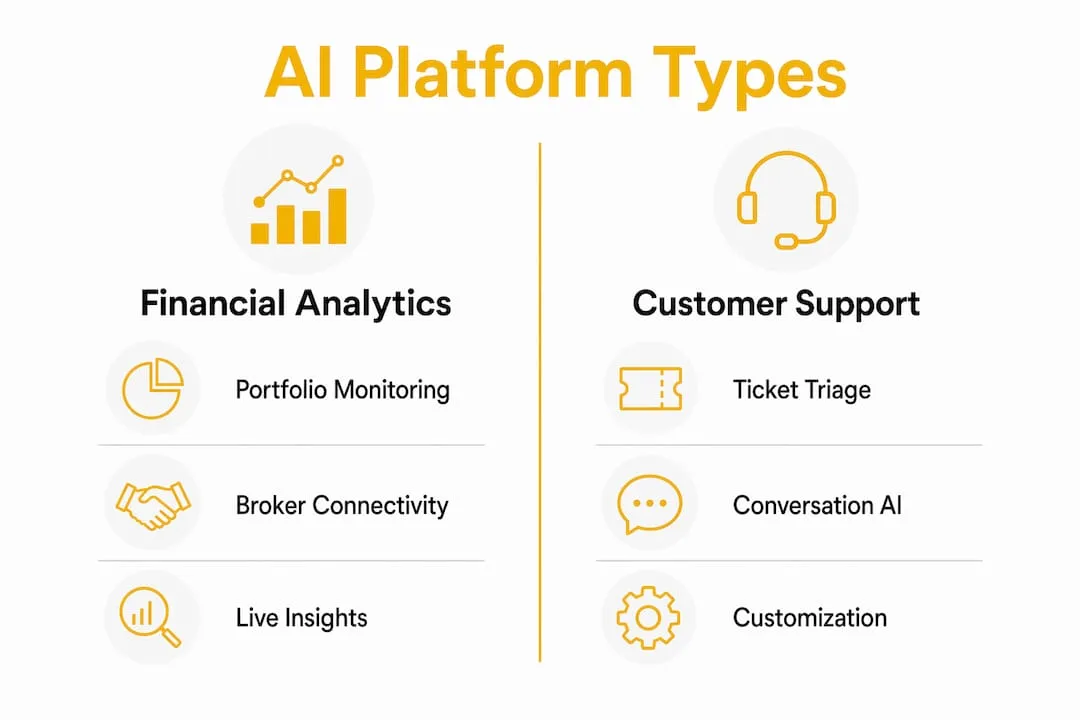
The U.S. market has bifurcated into two distinct AI platform types. Research-first tools provide deep market analysis, stock grading, and portfolio insights without connecting to live accounts. Agentic-first tools connect directly to broker accounts and act on live positions. Few platforms do both well, which is why practitioners increasingly run hybrid setups: one tool for live monitoring, another for in-depth research.
Key considerations for U.S. buyers evaluating this space:
- Asset class alignment matters. Crypto and DeFi portfolios have different monitoring needs than traditional equity accounts. Match your platform to your asset mix before committing.
- Agentic tools carry more risk. Platforms that execute trades or modify positions autonomously require careful permission scoping. Read-only integrations are safer starting points.
- Research-first tools suit long-term investors. If you’re not trading frequently, a platform focused on analysis and portfolio grading delivers more value than one optimized for execution speed.
- Hybrid setups outperform single platforms for professional users who need both live data and institutional-grade research. Always-on financial intelligence paired with a dedicated research tool covers more ground than any single platform currently on the market.
Planned: a different kind of financial AI
The platforms compared above are built for businesses, support teams, or professional investors. If you’re an individual trying to get a clearer picture of your own financial health, that’s a different problem entirely.
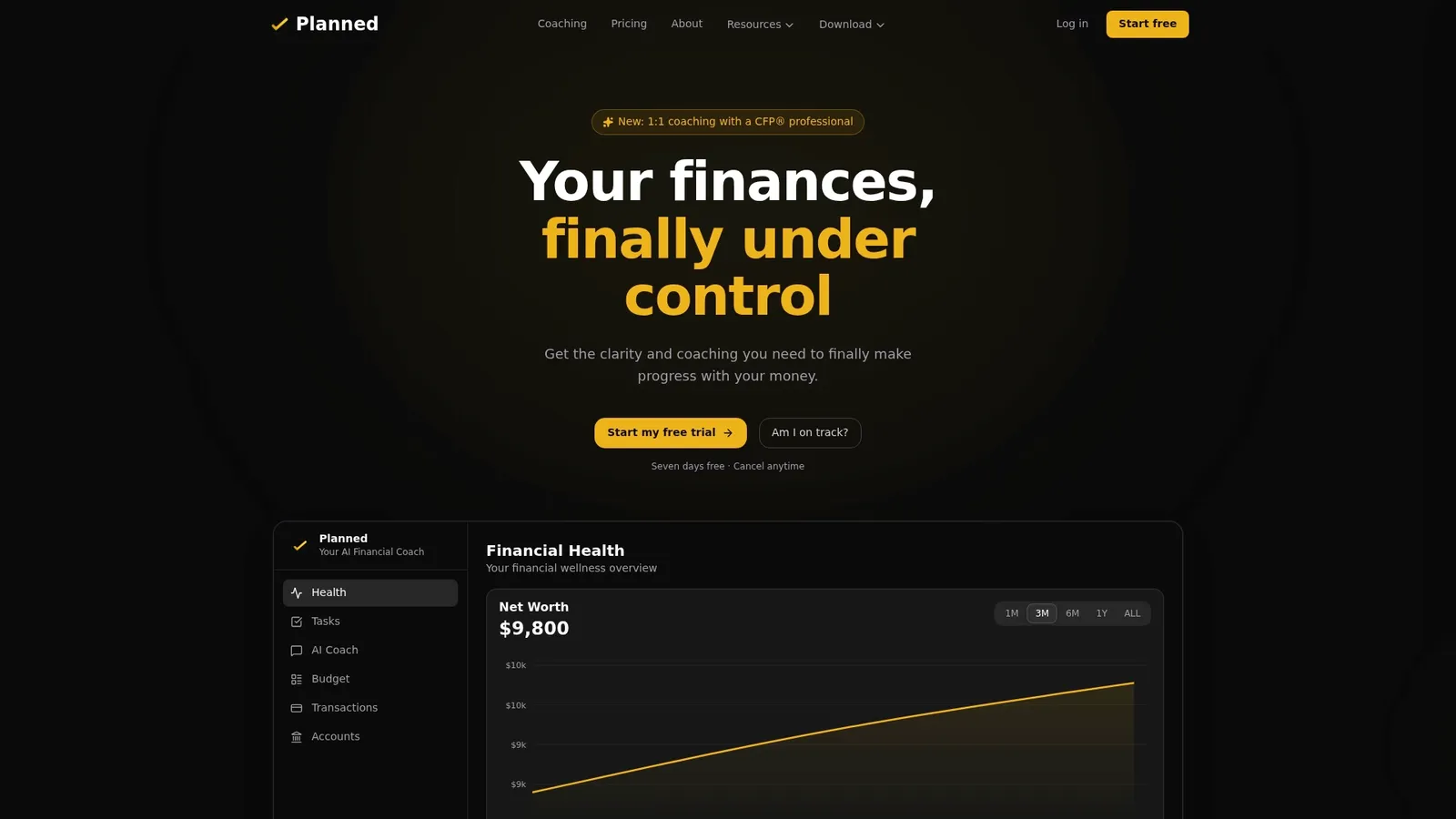
Planned connects directly to your real financial accounts and gives you a personalized AI coach that actually knows your numbers. Instead of generic advice, you get answers based on your actual income, spending patterns, and goals. The Financial Health Score gives you a clear, honest read on where you stand right now. If you’ve ever felt anxious about money without knowing exactly why, that kind of clarity tends to help more than any dashboard full of market data. Planned isn’t a trading tool or a support automation platform. It’s your personal financial coach, built for the person trying to make smarter decisions with the money they already have.
FAQ
What is the best AI tool for financial analysis in 2026?
The best tool depends on your specific need. Sierra AI and Lorikeet lead for live portfolio monitoring, while research-focused platforms like Finapolis suit investors who prioritize deep market analysis over automated execution.
Will AI replace human financial advisors?
AI handles high-volume, repeatable financial queries well, but complex judgment calls still benefit from human expertise. Most effective setups today combine AI for routine tasks with human advisors for nuanced decisions.
What are the most practical use cases for AI in finance?
The strongest use cases are portfolio monitoring, automated customer support for financial firms, fraud detection, and personalized financial coaching. Each requires a different type of platform, so matching the tool to the task is the critical first step.
How does Fin100X.AI differ from U.S. commercial AI platforms?
Fin100X.AI focuses on sovereign governance and public-sector intelligence in India, not retail investment or business customer support. U.S. users need commercial platforms with broker connectivity, transparent pricing, and compliance with U.S. financial regulations.
Is Planned a good alternative to the platforms in this comparison?
Planned serves a different audience: individuals seeking personalized financial coaching connected to their real accounts. If you’re a business or professional investor, the platforms above are the right fit. If you’re managing your own finances and want clarity on your financial health, Planned is worth a look.
Key Takeaways
The strongest fin100x.ai alternatives for U.S. users are commercial AI platforms built for financial analytics or customer support automation, not Fin100X.AI’s public-sector governance focus.
| Point | Details |
|---|---|
| Fin100X.AI is not built for U.S. users | It targets sovereign governance in India, with no broker connectivity or retail investment features. |
| Platform type determines fit | Research-first tools suit long-term investors; agentic tools suit teams needing automated execution or support. |
| Hugo offers the clearest budget entry | At $0.05 per interaction, it’s the most transparent pricing in this comparison. |
| Enterprise buyers should prioritize Salesforce Agentforce or Ada | Both offer deep integration, SOC 2 compliance, and dedicated onboarding support. |
| Planned suits individual financial coaching | For personal financial clarity connected to real accounts, Planned offers a different approach than any business-focused platform here. |
Recommended
Financial Coach vs Financial Advisor: How to Choose
Financial coach vs financial advisor: pick a coach if your problem is budgeting, debt, or saving, an advisor if it's your portfolio. Here's how to tell which.
What Is a Personal Financial Assessment?
A personal financial assessment scores your income, debt, savings, and cash flow from 0 to 100 so you know exactly what to fix first. Here is how to run one.
What Is Adaptive Financial Guidance and Why It Matters
Adaptive financial guidance updates your plan when your income, spending, or goals change. How it differs from static advice, and how to tell if a tool adapts.
Ways to Benchmark Your Finances: A Practical Guide
Benchmark your finances with four ratios: savings rate, retirement multiple, emergency fund months, and debt-to-income. Real 2026 figures and how to use them.