
How to Assess Financial Wellness in 2026: Your Checkup Guide
Learn how to assess financial wellness 2026 with our comprehensive guide. Understand your financial health and make informed choices today!
 Planned Team·
How to Assess Financial Wellness in 2026: Your Checkup Guide
What does assessing your financial wellness actually mean in 2026?
Financial wellness is the state of having enough security to cover your needs and enough freedom to make choices that reflect your values. Assessing it means taking an honest look at where you stand across five core areas: debt, savings, cash flow, credit health, and future planning. Think of it less like a report card and more like a health checkup. You are not grading yourself. You are getting a clear picture so you can act.
The Consumer Financial Protection Bureau (CFPB) measures this through a financial well-being score ranging from 0 to 100. People scoring in the “Very High” range typically have at least $10,000 in liquid savings and automated retirement contributions, while those in the “Very Low” range (0–29) often struggle to cover even a $2,000 emergency. That gap is wide, but the distance between those two points is mostly made up of consistent habits and clear information.
In 2026, the context matters too. Inflation, shifting interest rates, and a growing set of AI-powered financial tools have changed what a thorough personal finance checkup looks like. The good news: you have more resources than ever to do this well.
What a financial wellness assessment covers:
- Debt load: total balances, interest rates, and monthly obligations
- Savings rate: emergency fund size, retirement contributions, and short-term reserves
- Cash flow: income versus spending, including discretionary patterns
- Credit health: score, history, and any errors on your report
- Future planning: insurance coverage, beneficiaries, and long-term goals
Why a financial wellness checkup matters more in 2026
Skipping a financial checkup does not mean your finances stay the same. It usually means small problems quietly grow. A checkup forces blind spots into the open, whether that is a subscription you forgot about, a credit card balance creeping up, or a retirement account you have not touched in two years.
The 2026 economic environment adds urgency. Interest rates on consumer debt remain elevated, which means carrying a balance costs more than it did a few years ago. Inflation has shifted household budgets in ways that are easy to miss month to month but obvious when you look at a full year of spending. A financial health assessment done now gives you a baseline before those pressures compound further.
There is also a mental health dimension here. Financial stress is one of the leading sources of anxiety for Americans, and the connection runs both ways. Stress makes it harder to make clear financial decisions, and unclear finances create more stress. Getting organized breaks that cycle.
January is National Financial Wellness Month, making Q1 the ideal time to review your finances with a focus on clarity rather than perfection.
- Checkups reveal spending patterns you cannot see in real time
- They help you prioritize which financial problems to tackle first
- Regular reviews build the habit of proactive money management
- They reduce the anxiety that comes from financial uncertainty
How to perform your own financial wellness checkup, step by step
Start by gathering your numbers. Pull together your most recent pay stubs, bank statements, credit card balances, loan statements, and investment account summaries. You cannot assess what you cannot see, so this step is non-negotiable.

Step 1: Map your debt. List every debt with its balance, interest rate, and minimum payment. This gives you a true picture of your debt load and helps you spot which balances are costing you the most. High-interest credit card debt typically deserves attention first.
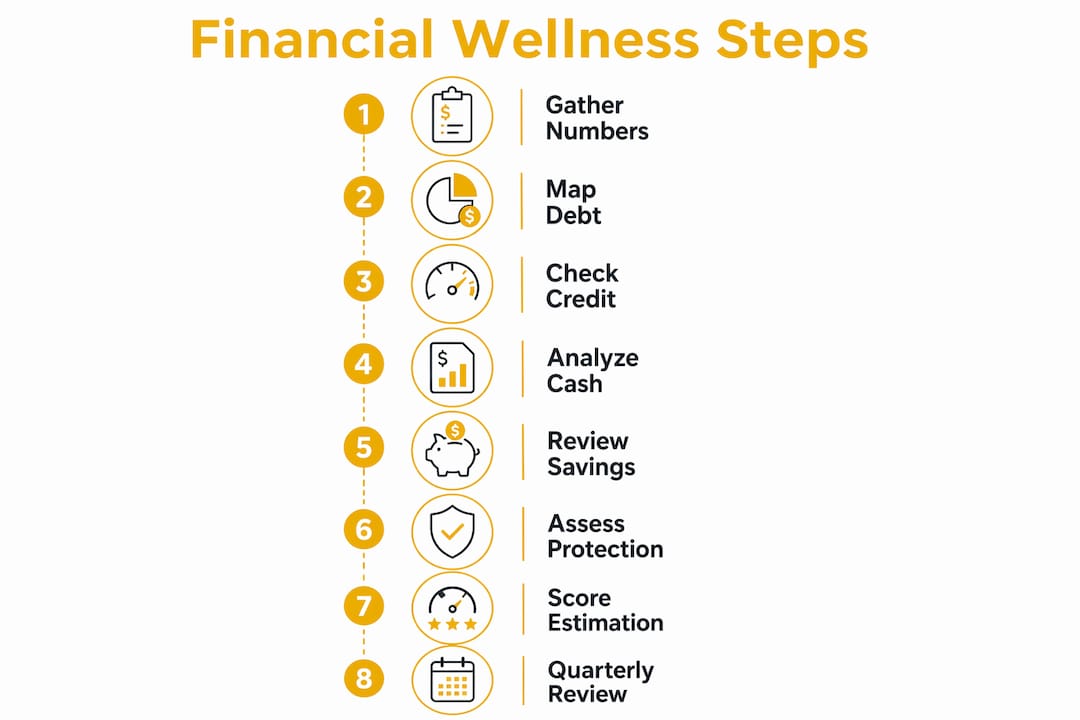
Step 2: Check your credit. Pull your free credit report from AnnualCreditReport.com and review it for errors. Experian’s Financial Health Assessment uses an 8-question survey covering spending, saving, borrowing, and future planning to produce a score that guides improvement without affecting your credit.
Step 3: Analyze your cash flow. Track every dollar coming in and going out for at least 30 days. Separate essential spending (rent, groceries, utilities) from discretionary spending (dining out, subscriptions, impulse purchases). Tracking household spending consistently is the single most revealing thing you can do early in this process.
Step 4: Review your savings. Compare your emergency fund against the FDIC’s recommendation of six months of living expenses. Check whether you are contributing to a retirement account and whether your beneficiary designations are current.
How does my money actually stack up?
Most people feel behind financially but have no idea where they actually stand.

Step 5: Assess your protection. Review your insurance coverage (health, life, disability, renters or homeowners) and confirm your estate planning documents are up to date. These are easy to neglect and expensive to ignore.
Step 6: Estimate your financial well-being score. Use the CFPB’s scale as a benchmark. Knowing whether you fall in the “Medium Low” (38–49) or “High” (58–67) range helps you set realistic targets rather than comparing yourself to misleading averages.
Pro Tip: Set a recurring calendar reminder every quarter to repeat this checkup. A one-time review is useful. A quarterly habit is what actually changes your trajectory.
Practical tips to improve your financial wellness in 2026
Once you have your baseline, the next question is: what do you do with it? The answer depends on where your gaps are, but a few strategies apply broadly.
Set goals that are specific and measurable. “Save more money” is not a goal. “Build a $5,000 emergency fund by october” is. The CFPB’s savings guidance consistently points to specific, time-bound goals as the driver of follow-through.
Use the 50/30/20 framework as a starting point. The CFPB suggests allocating roughly 50% of your income to needs, 30% to wants, and 20% to savings and debt repayment. You may need to adjust those percentages based on your situation, but the structure gives you a clear starting point for understanding your monthly spending.
Automate everything you can. Automatic transfers to savings, automatic bill payments, and automatic retirement contributions remove the friction that causes most people to fall short. Automation reduces the mental load of managing money, freeing your attention for decisions that actually require thought.
Address the emotional side. Dr. Erika Rasure’s Financial Wellness RESET™ framework makes the case that psychological and identity-level money habits must be addressed for lasting change. Budgeting tools alone rarely fix patterns rooted in anxiety, avoidance, or past financial trauma. If you notice you consistently overspend in certain categories or avoid looking at your accounts, that pattern is worth examining directly.
- Pay down high-interest debt before adding to investments
- Avoid taking on new debt unless it serves a clear, planned purpose
- Review your budget whenever your income or expenses change significantly
- Build financial literacy as an ongoing habit, not a one-time event
Pro Tip: Pick one small habit to add this week, such as a five-minute weekly money check-in. Small, consistent actions compound faster than occasional big efforts.
How personalized AI coaching can sharpen your financial wellness assessment
Self-assessment gets you far. AI-assisted coaching takes you further. The difference is that an AI coach connected to your real financial accounts does not give you generic advice. It sees your actual income, your spending patterns, and your goals, then responds to your specific situation.
Planned’s AI coach works exactly this way. When you ask “Can I afford to increase my retirement contribution this month?” it pulls from your real account data to give you a grounded answer, not a rule of thumb. That kind of personalized financial guidance reduces the anxiety that comes from uncertainty and builds genuine confidence over time.
Features like Planned’s Financial Health Score give you a single, trackable number that reflects your overall financial picture. You can watch it move as you pay down debt, grow your savings, or fix a cash flow problem. That feedback loop is motivating in a way that spreadsheets rarely are.
The behavioral dimension matters here too. AI coaching can detect spending patterns you might not notice yourself, flag when your habits are drifting from your goals, and prompt you to revisit your plan when life changes. Combined with the RESET™ framework’s emphasis on psychological factors, this kind of adaptive feedback addresses both the mechanical and emotional sides of financial wellness.
- AI coaching connects to real accounts for precise, personalized insights
- Goal monitoring tracks progress without requiring manual updates
- Spending pattern detection surfaces habits before they become problems
- Ongoing feedback loops keep your plan aligned with your actual life
Key Takeaways
Assessing your financial wellness in 2026 means measuring debt, savings, cash flow, credit health, and future planning against clear benchmarks, then acting on what you find.
| Point | Details |
|---|---|
| Use the CFPB score as your benchmark | Scores range from 0–100; a “Very High” score (68–100) typically means at least $10,000 in liquid savings. |
| Start with a full data gather | Collect debt balances, income, expenses, and account statements before drawing any conclusions. |
| Automate to reduce friction | Automatic savings and bill payments remove the decisions that most often derail financial progress. |
| Address behavior, not just numbers | Psychological money habits, as outlined in the Financial Wellness RESET™ framework, drive lasting change. |
| Reassess every quarter | A one-time checkup is a snapshot; quarterly reviews turn awareness into a sustained improvement habit. |
FAQ
What is financial wellness and how is it measured?
Financial wellness is the state of having financial security and the freedom to make choices that reflect your values. The CFPB measures it with a scored scale from 0 to 100, covering savings, debt management, and financial resilience.
How often should you do a financial wellness checkup?
A thorough checkup once a year is a solid foundation, but quarterly reviews let you catch problems early and adapt to income or expense changes before they compound.
What score on the CFPB scale indicates good financial health?
A score of 58–67 falls in the “High” range, where most people can cover a moderate emergency with confidence. Scores of 68 and above are “Very High,” typically associated with at least $10,000 in liquid savings.
Can an AI coach replace a certified financial counselor?
AI coaching excels at real-time, personalized insights based on your actual account data, but a certified financial professional adds judgment, accountability, and expertise for complex decisions like tax planning or estate strategy.
What is the fastest way to improve your financial wellness score?
Building even a small emergency fund and automating a monthly savings transfer tend to produce the quickest measurable improvements, since both directly address the savings and resilience components that weigh heavily in most financial wellness frameworks.
Recommended
Financial Coach vs Financial Advisor: How to Choose
Financial coach vs financial advisor: a coach fixes budgeting, debt, and habits at $100 to $300 an hour. An advisor manages investments for about 1% a year.

What Does Financial Empowerment Mean for You?
Discover what financial empowerment means for you. Gain the confidence to make informed money decisions and take control of your financial future.
The Role of Budgeting in Debt Reduction: 2026 Guide
Discover the role of budgeting in debt reduction. Learn how to create a plan that ensures payments and channels funds toward debt payoff.
What Is a Personal Financial Assessment?
A personal financial assessment scores your income, debt, savings, and cash flow from 0 to 100 so you know exactly what to fix first. Here is how to run one.
See my financial health score.
Most people feel behind but have no idea where they actually stand. Score yourself across all 10 areas in 2 minutes.
Am I on track?